
Your skin does not simply rest while you sleep — it runs a precise, multi-phase biological repair programme governed by molecular clock genes (BMAL1, CLOCK, PER, CRY) that have evolved specifically to exploit the UV-free dark hours. Cell proliferation peaks between 9pm–midnight (keratinocytes divide up to 30 times more actively than at midday). Growth hormone releases 50–70% of its daily total during this same window, driving collagen synthesis. DNA repair from UV photodamage peaks at midnight–2am. The skin’s ceramide and lipid barrier is actively restored between 3–5am. And throughout the entire night, with no UV signals activating melanin production, the dark phase is the most effective window for tyrosinase-inhibiting brightening actives. For Indian skin — which accumulates more UV damage and is more reactive to pigmentation triggers than lighter skin types — this repair window is proportionally more important, and consistently missing it (through late nights, irregular sleep, or poor sleep quality) has directly documented effects on melanin overproduction and dark spot persistence.

There is a reason skin looks different in the morning than it did the night before. Not just rested — actually different. Pores less visible. Tone more even. Dullness reduced. This is not your imagination, and it is not simply the result of whatever you applied before bed.
It is the result of a precisely timed biological repair programme that your skin runs every single night — governed by molecular clocks inside every skin cell, coordinated by hormones, driven by genes that have evolved over millions of years specifically to protect and rebuild during the dark. Your skincare routine can either work with this repair window or ignore it. For Indian skin dealing with pigmentation, barrier stress, and year-round intense UV exposure, the difference between the two is significant.
This guide explains exactly what your skin does while you sleep, when it does it, why Indian skin has specific considerations that most overnight skincare advice misses, and how to build a night routine that works with — rather than simply sitting alongside — your skin’s own biology.
Most people think of the body’s biological clock as something that makes them feel sleepy at night. The reality is more specific and more remarkable. Every single cell in your skin — every keratinocyte, every fibroblast, every melanocyte — contains its own molecular clock. Not a metaphorical clock. Actual genes, cycling in precise 24-hour feedback loops, switching different cellular processes on and off with biological accuracy.
These four gene families form the core of the skin circadian clock. BMAL1 and CLOCK are the activators — they switch on the genes that drive daytime protection functions: antioxidant defences, barrier maintenance, UV response. PER and CRY are the repressors — as they build up during the day, they eventually suppress CLOCK/BMAL1 activity, switching the skin from protection mode into repair mode. This suppression at night is what enables the cellular processes — collagen synthesis, DNA repair, barrier restoration — that cannot run efficiently during the day because the resources are occupied with UV defence.
A landmark study published in MDPI International Journal of Molecular Sciences (2016) confirmed that in human skin, hundreds of genes oscillate with circadian rhythmicity, with BMAL1 and CLOCK directing daytime oxidative defence while PER and CRY proteins regulate the shift into overnight repair. A 2024 MDPI review of UV damage and DNA repair across the circadian cycle confirmed that DNA repair efficiency peaks at night when UV exposure is absent — the skin uses the dark hours to fix photodamage accumulated during daylight, guided by BMAL1-controlled repair mechanisms. A PubMed 2012 study on BMAL1 and keratinocyte proliferation confirmed that keratinocyte-specific deletion of BMAL1 obliterates time-of-day cell division — directly proving that the circadian clock controls when skin cells divide, not just whether they divide.
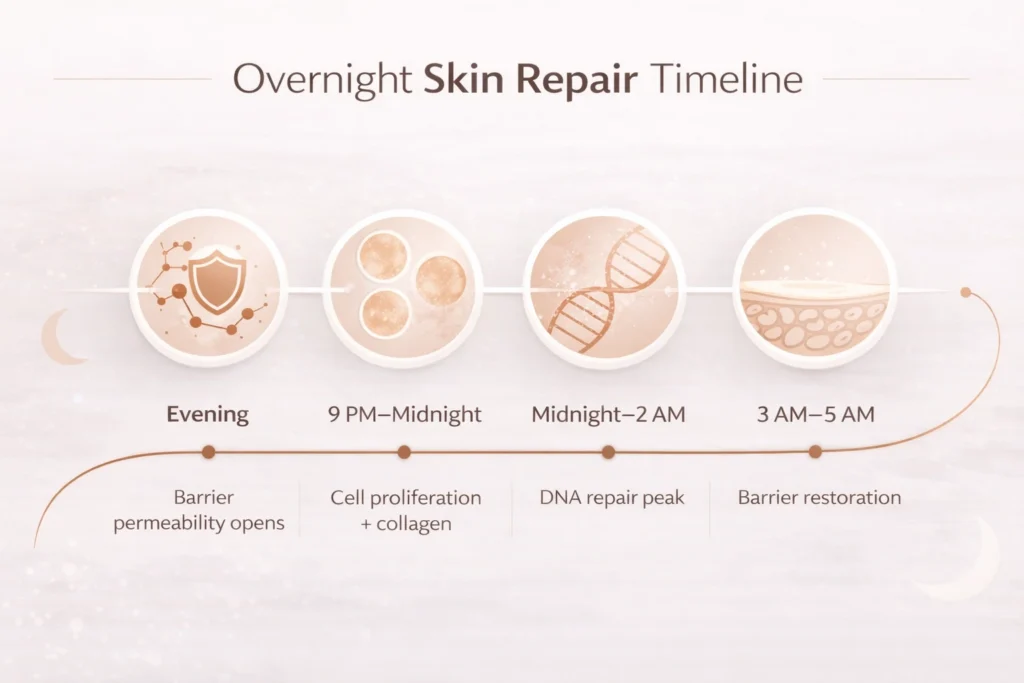
This question — what actually happens to skin while you sleep — has a specific, hour-by-hour biological answer. Most people are surprised to learn how organised the process is.
PER and CRY proteins, accumulating all afternoon, reach peak concentration and begin suppressing the CLOCK/BMAL1 complex. This is the biological handover from day-mode to night-mode. Blood vessels in the dermis dilate, bringing increased oxygen and nutrients to the areas that will be replenished. Skin permeability begins to rise — the tight junctions between cells loosen slightly, creating the conditions for deeper ingredient penetration. This is the reason skincare applied in the evening is demonstrably more absorbable than the same product applied in the morning. Applying your night cream immediately after your evening cleanse — while skin is still slightly damp — takes advantage of this permeability peak before it begins to reverse.
This is the most important two-to-three-hour window in your skin's 24-hour cycle. Keratinocytes — the skin cells that form the visible outer layer — shift into active proliferation. The MDPI IJMS 2016 study on biological rhythms in the skin confirms that keratinocytes proliferate up to 30 times more actively at night than at midday — a finding supported by the PubMed 2012 BMAL1 keratinocyte study. Simultaneously, 50–70% of the body's daily growth hormone is released during the first deep sleep cycles — the hormone that drives fibroblast activity and therefore collagen and elastin synthesis. Miss the 10pm–midnight window and you miss the richest repair phase of the night. For Indian skin, this window is also when melanin suppression is most biologically effective — with no UV signals driving tyrosinase activity, brightening actives applied in the evening work at the most receptive moment in the 24-hour cycle.
The 2024 MDPI review on circadian rhythms and DNA repair in skin photoaging confirmed that nucleotide excision repair — the primary mechanism for clearing UV-induced DNA damage — peaks in the midnight to 2am window. This is when the skin systematically identifies and repairs cyclobutane pyrimidine dimers (CPDs): photoproducts created by UV radiation that accumulate in skin cells during daylight and, if uncorrected, contribute to premature ageing and pigmentation changes. For Indian skin exposed to high-intensity Kerala and South India UV daily, this repair window is processing a significantly larger UV damage backlog than skin in lower-UV environments. Disrupting sleep in this specific window — common with screen use and late-night habits — leaves UV damage partially uncleared.
In the pre-dawn hours, the skin shifts focus from cellular repair to barrier restoration. Ceramides — the lipid molecules that form the waterproof cement between skin cells — are actively synthesised. Filaggrin and loricrin, the structural proteins that maintain the cornified envelope, are replenished. Transepidermal water loss reaches its daily minimum during this window, reflecting a tightly sealed, fully restored barrier. This is the biological baseline your skin is trying to achieve every morning before UV exposure begins again. Products with heavy silicones or thick occlusives applied overnight can interfere with this natural lipid synthesis process — which is why a clean, non-occlusive night cream formulation matters specifically for Indian skin.
The 18-year Kerala UV Index satellite study (PubMed 2024) found over 79% of daily UV readings across Kerala in the Very High to Extreme category — not just in summer, but year-round. Every day, Indian skin in South India accumulates UV-induced DNA damage, reactive oxygen species, and melanin-driving inflammatory signals that the overnight window must repair. The midnight–2am DNA repair phase is processing a larger backlog than skin in temperate climates. Any disruption to sleep quality or timing — late nights, irregular schedules, screen exposure into the night — delays or compresses this repair window, leaving UV damage uncleared to compound the next day.
A 2025 PMC study published in the Indian Dermatology Online Journal confirmed the direct biological link between poor sleep and worsened skin pigmentation. The mechanism: sleep deprivation disrupts circadian clock gene expression (BMAL1 and PER1 specifically), which directly influences melanocyte activity and melanin production rate. For Indian Fitzpatrick III–VI skin — already producing more melanin in response to triggers than lighter skin types — circadian rhythm disruption adds another melanin driver on top of daily UV exposure and PIH from acne. This is why patients with irregular sleep patterns frequently report worsening dark spots and uneven tone that cannot be explained by their topical routine alone.
A 2024 survey of 379 Indian dermatologists and cosmetologists published in IJORD found that 97% of surveyed doctors believed the majority of their patients required both day and night cream to maintain their skin’s circadian rhythm. Among 2,085 patients assessed, 49.4% experienced considerable reduction in dark spots and uneven skin tone with a consistent day-and-night cream regimen. The survey concluded that Indian healthcare professionals understand the impact of skin circadian rhythm imbalance and actively promote comprehensive morning-to-evening routines — making circadian-aligned skincare one of the highest-evidence approaches in current Indian dermatology practice.
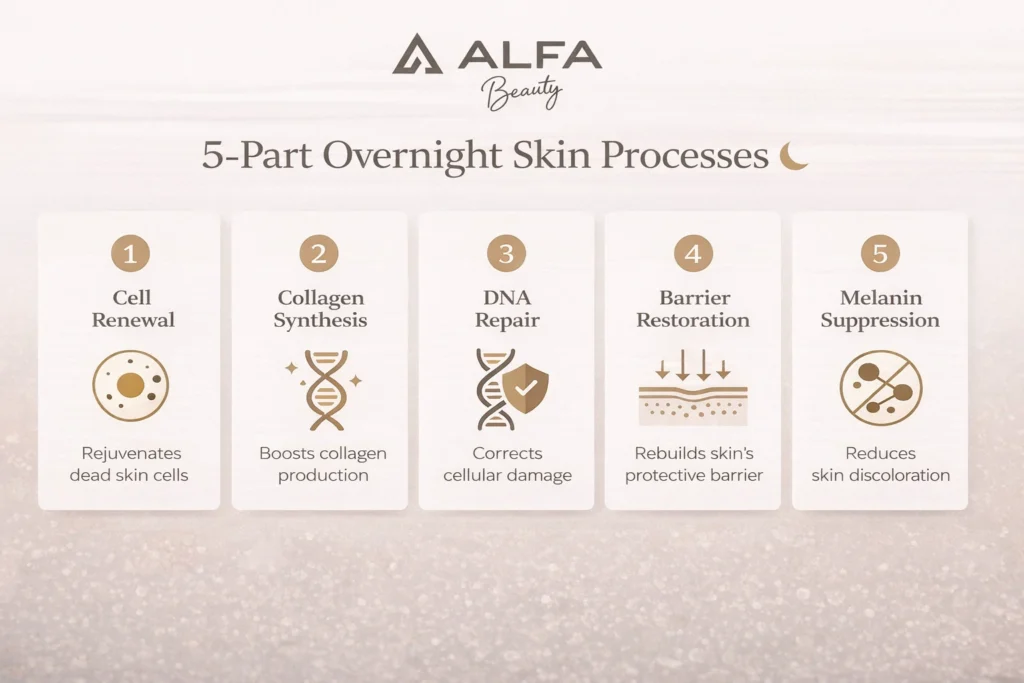
| What Skin Does | When It Peaks | What Supports It | What Disrupts It |
|---|---|---|---|
| Cell Renewal (Keratinocyte proliferation) | 9pm–Midnight | Consistent sleep timing. Sulfate-free cleanser — no barrier stripping. Aloe Vera for barrier support overnight. | Late or irregular sleep. Harsh cleansers before bed. Alcohol-based products that stress keratinocytes. |
| Collagen Synthesis (Fibroblast activity) | 9pm–Midnight (GH surge) | Deep sleep in the first half of the night. Niacinamide supports fibroblast function and collagen production. Adequate hydration. | Missing the 10pm–midnight window. Alcohol (suppresses GH release). Cortisol from poor-quality or late sleep. |
| DNA Repair (UV photodamage clearance) | Midnight–2am | Uninterrupted sleep in this window. Antioxidant support from Aloe Vera. SPF the following morning prevents fresh UV damage being added back. | Screen light exposure past midnight (disrupts melatonin). High UV accumulation without SPF the prior day. |
| Barrier Restoration (Ceramide + lipid synthesis) | 3am–5am | Night cream with barrier-supporting actives. Non-comedogenic base that does not clog lipid assembly. Aloe Vera acemannan polysaccharide. | Silicones forming occlusive films over natural lipid synthesis. Physical scrubs or acids close to bedtime. Dry, low-humidity air conditioning. |
| Melanin Suppression (UV-free dark phase) | All night (UV-absent window) | Kojic Acid (tyrosinase inhibition during no-UV window). Niacinamide (melanosome transfer block). Applied consistently every evening. | Disrupted sleep reducing suppression window. UV exposure next morning without SPF re-triggering melanin. Irregular application — skipping nights. |
The single most important preparatory step. After a day of SPF, pollution particles, and oxidative residue, the skin needs a thorough but gentle cleanse before the repair window opens. Sulfate-free cleanser only — sulfates strip the lipid barrier that the skin spent the previous 3–5am restoring. A double cleanse (oil cleanser first to dissolve SPF, followed by a water-based cleanser) is particularly valuable for Indian urban skin, which accumulates PM2.5 and other pollutants that single cleansing often leaves behind. Pollutant residue on the skin overnight generates oxidative stress that works directly against the DNA repair the skin is trying to perform.
An alcohol-based toner applied after cleansing damages the slightly-opened barrier permeability that makes evening ingredient penetration so effective — and adds unnecessary inflammation that can trigger PIH on Indian acne-prone skin. If toning feels necessary, a pH-balancing, alcohol-free mist or essence is the alternative. For most Indian skin types, cleansing well and moving directly to the night cream is equally effective and significantly less likely to cause the micro-irritation that generates new dark spots.
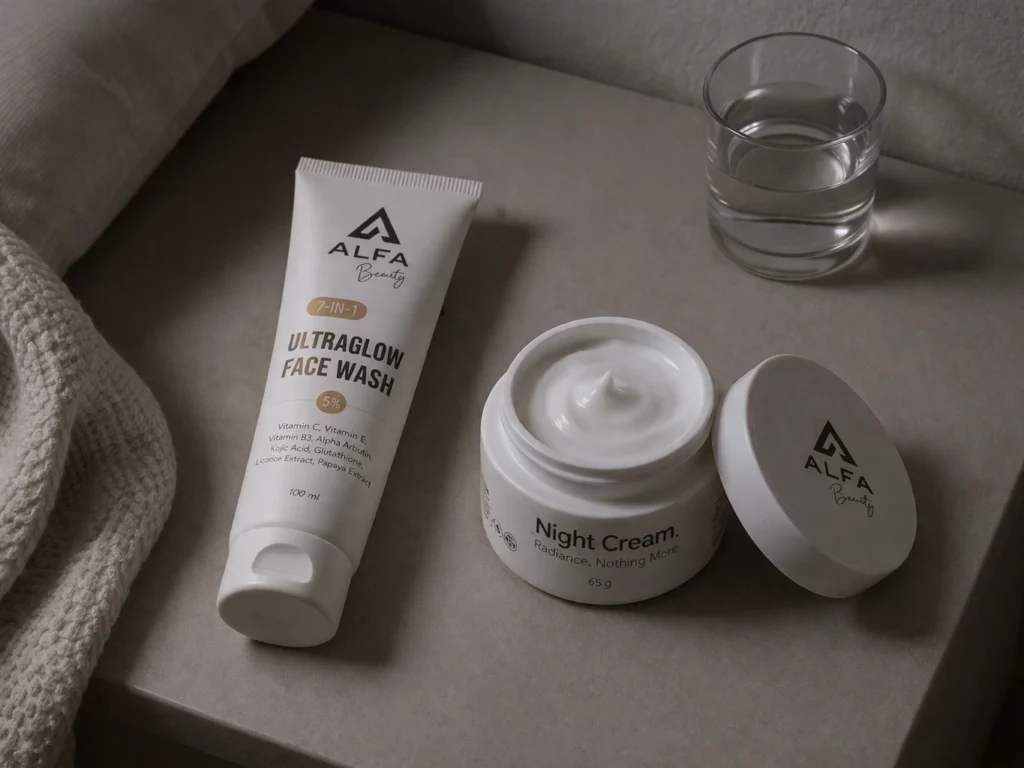
Apply 2–3 minutes after cleansing, while skin is still slightly damp. Damp skin has a reduced transepidermal barrier, which increases absorption of water-soluble actives like Niacinamide. The active ingredients — Kojic Acid, Niacinamide, and Aloe Vera in Alfa Beauty Night Cream — are designed to be absorbed during the evening permeability window and work throughout the repair cycle. Use a small amount (a 5-paisa coin-sized amount covers the full face for most Indian skin types). Overloading does not increase efficacy and can lead to congestion on oily or combination Indian skin.
For most Indian skin types — oily, combination, or acne-prone — adding a heavy occlusive (petroleum jelly, mineral oil) on top of the night cream interferes with the natural lipid synthesis that peaks between 3–5am. The skin’s ceramide and fatty acid production benefits from slight exchange with the environment. Thick occlusives can block this and lead to congestion. If your skin is extremely dry and barrier-compromised, a small amount of occlusives applied only to the driest patches is appropriate — not all-over.
| Mistake | What It Disrupts | The Fix |
|---|---|---|
| Sleeping past midnight regularly | Misses peak cell proliferation (9pm–midnight) and collagen synthesis (GH surge). UV damage accumulates partially unrepaired as the DNA repair cycle is compressed. | Aim for sleep before midnight as the baseline. Occasional late nights are manageable — a chronic pattern is the problem for Indian skin dealing with PIH. |
| Using harsh toners or acids directly before bed | Damages the barrier that the skin spends 3–5am restoring. Acid-induced inflammation on Indian skin triggers PIH responses that add pigmentation rather than reducing it. | Replace with alcohol-free toner or skip toning at night. Reserve active acids for mornings when the barrier is at full strength. |
| Applying too many products layered over the night cream | Thick occlusive layers (especially silicones) prevent natural ceramide and lipid synthesis that peaks pre-dawn. Congests pores on Indian oily and acne-prone skin. | Night cream alone is sufficient for most Indian skin. A light oil on dry patches only, if needed. |
| Skipping SPF the morning after | UV exposure immediately reverses overnight melanin suppression achieved by Kojic Acid and Niacinamide. | SPF 50 PA+++ every morning, consistently — not optional for Indian skin. |
| Inconsistent application — skipping nights | Kojic Acid and Niacinamide work only while present. Skipping nights allows melanin production to resume unchecked. | Night cream every night — consistency is the most important variable. |
A question worth answering directly: how many hours of sleep does skin actually need for the full overnight repair cycle? The 2025 MDPI Sleep-Skin Axis review and the PMC sleep quality and skin pigmentation study both indicate that 7–9 hours provides the complete cycle — cell proliferation (9pm–midnight), DNA repair (midnight–2am), and barrier restoration (3–5am) — without compression. Less than 7 hours consistently compresses or eliminates one or more phases. For Indian skin dealing with hyperpigmentation, 7+ hours is not a general wellness recommendation. It is a biological requirement for the overnight processes that dark spot fading depends on. Alfa Beauty Night Cream amplifies the repair that adequate sleep makes possible — it does not replace the sleep itself.
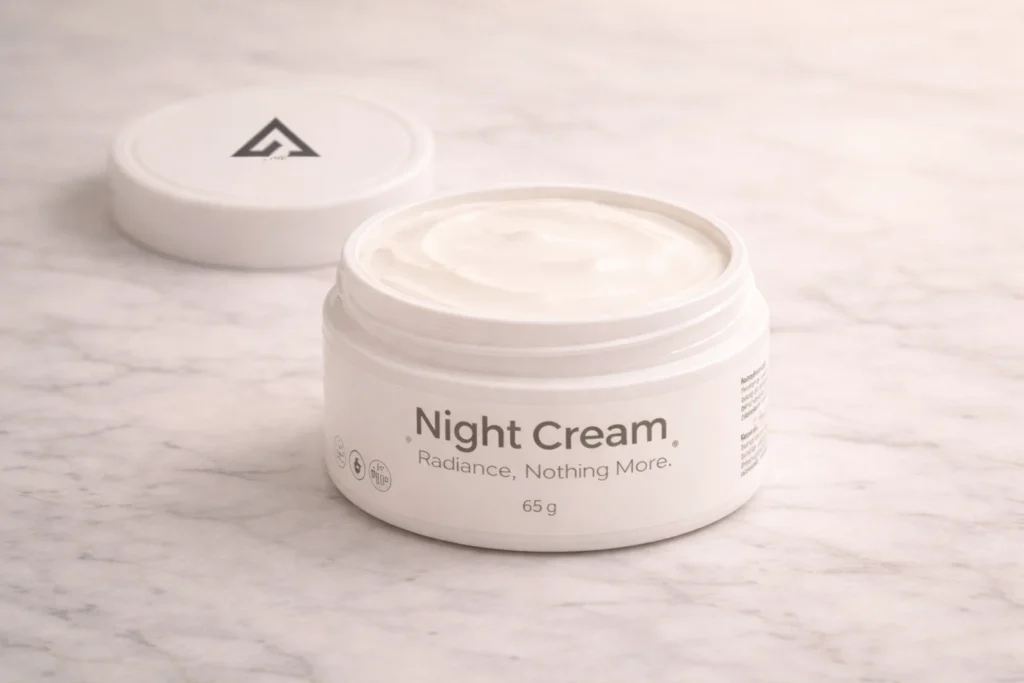
Every ingredient in Alfa Beauty Night Cream is chosen for its role in the specific biological processes that happen while you sleep — not for label appeal or trending ingredient status. Here is how each active maps to the overnight repair phases described throughout this guide:
Kojic Acid + Niacinamide + Aloe Vera — Made for Indian Skin
| Ingredient | Overnight Repair Role | Which Repair Phase | Clinical Basis |
|---|---|---|---|
| Kojic Acid | Inhibits tyrosinase during the UV-absent dark phase — the most biologically effective window for melanin suppression because no UV signals are competing to re-activate melanin production. | Melanin Suppression: All night (UV-free window) | PMC 2023 | Indian RCT | IJORD 2025 |
| Niacinamide | Inhibits melanosome transfer (35–68% inhibition in trials) + supports collagen synthesis during GH surge + strengthens the ceramide barrier in pre-dawn hours. |
Melanin transfer: All night; Collagen support: 9pm–midnight; Barrier: 3–5am |
PMC 2021 | BJD RCT | vs HQ RCT |
| Aloe Vera (Aloesin) | Adds third tyrosinase inhibition pathway + accelerates barrier lipid synthesis from 3–5am + reduces overnight inflammation that contributes to PIH. |
Barrier restoration: 3–5am; Melanin inhibition: all night; Anti-inflammatory: all night |
PMC Natural Cosmetics | PMC Aloe Vera |
Your skin is not passive while you sleep. It is running one of the most complex, precisely timed biological programmes in the body — shifting from UV defence to cellular repair, producing collagen, clearing UV-induced DNA damage, restoring the barrier lipid layer, and suppressing the melanin drivers that create the dark spots you are trying to fade.
A well-chosen night cream with the right active ingredients — Kojic Acid to suppress melanin in the UV-free dark window, Niacinamide to block melanin transfer and support fibroblasts, Aloe Vera to restore the barrier that everything else depends on — works with this biology, not alongside it. Applied consistently, at the right time, in a clean formulation free of barrier-disrupting additives.
But the night cream is only as effective as the sleep it works in. Consistent sleep timing, protection of the midnight–2am DNA repair window, a sleeping environment that does not disrupt melatonin production — for Indian skin dealing with daily high-intensity UV exposure in South India and Kerala, these are the biological conditions your brightening routine requires to deliver.