
The best night cream for oily skin in India is non-comedogenic, silicone-free, alcohol-free, and fragrance-free — with Niacinamide as the lead active ingredient. Contrary to the widespread belief that oily skin does not need a night cream, oily skin still loses water from deeper layers overnight through transepidermal water loss (TEWL). Dehydrated oily skin responds by producing more sebum — worsening oiliness. Niacinamide at 2–5% is the most clinically validated ingredient for oily Indian skin: it reduces sebum excretion rates (confirmed in a published clinical trial on Oriental populations), blocks melanin transfer to surface cells, reduces acne lesion counts, and strengthens the barrier — all in a water-based, non-greasy delivery that is specifically suited to India’s humid climate conditions. For brightening, Kojic Acid targets tyrosinase overnight in the UV-free window, fading the PIH dark marks that appear after every oily-skin breakout. Applied in a pea-sized amount every evening after cleansing, a correctly formulated non-comedogenic night cream is the single highest-return skincare step for oily Indian skin.

If you have oily skin in India, you have probably heard — or believed — some version of this: oily skin doesn’t need moisturizer. It produces enough oil on its own. Adding a night cream will only make it worse. This is one of the most damaging myths in Indian skincare, and it is behind a cycle of worsening oiliness, more breakouts, and more post-acne dark spots that most people with oily skin cannot figure out how to escape.
This guide addresses it with the science: why oily skin loses water at night regardless of how much sebum the surface produces, which ingredients are specifically proven for oily Indian skin, what makes a product non-comedogenic in practice rather than just on the label, and how to use a night cream correctly so that it works with your skin’s overnight biology rather than clogging it overnight. At the end, you will have a complete, actionable picture — and an honest answer to every oily-skin night cream question you have been searching for.
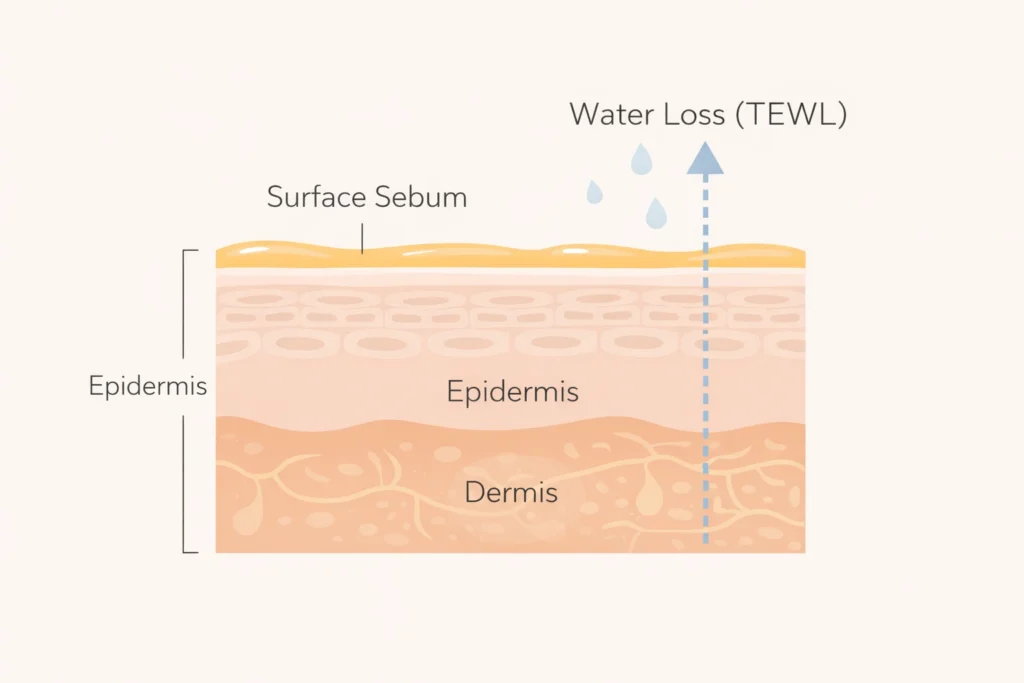
Here is the distinction that explains everything: sebum — the oil your skin produces — sits on the surface. It does not hydrate the skin from within. Hydration comes from water content in the deeper layers of the epidermis. Transepidermal water loss (TEWL) is the rate at which water escapes from these deeper layers through the skin surface into the surrounding air. And TEWL happens in oily skin at night at essentially the same rate as any other skin type.
The result: despite a visibly oily surface, the deeper skin layers in oily skin are often chronically under-hydrated. This dehydration has a direct consequence — the sebaceous glands produce more sebum as a compensatory response to barrier stress. This is the paradox that traps most people with oily skin: the more they strip, dry out, or skip moisturization, the more oil their skin produces.
Oily Indian skin faces a specific and compounding problem: sebum overproduction creates the conditions for acne. Acne creates inflammation. Inflammation triggers melanocyte overproduction in Fitzpatrick III–V skin. That melanin overproduction becomes Post-Inflammatory Hyperpigmentation (PIH) — the dark mark that persists for months after the original pimple has cleared. A non-comedogenic, Niacinamide-led night cream interrupts this cycle at three points simultaneously: regulating sebum production, reducing acne inflammation, and blocking melanin transfer that creates PIH dark marks.
| The Myth | The Science |
|---|---|
| Oily skin doesn't need a night cream — it produces enough oil already. | Sebum (oil) and skin hydration are different things. Oily skin still loses water through TEWL overnight. Skipping night cream dehydrates the barrier, which triggers more sebum production — worsening oiliness. A lightweight, non-comedogenic night cream breaks this cycle. |
| Night cream will clog my pores and cause breakouts. | Comedogenicity depends on formulation — not on the product category. A silicone-free, oil-free, alcohol-free, non-comedogenic night cream with Niacinamide is clinically tested to not clog pores. The problem is heavy, oil-rich formulations — not night cream itself. |
| Applying night cream in India's humidity makes oily skin worse. | Night cream does not add oil to the skin — it delivers water-soluble actives. In humid conditions, lightweight formulas absorb quickly and do not sit on the surface. Oiliness issues come from congestion, not from properly formulated night cream. |
| Moisturising oily skin is counterproductive. | This confuses sebum (surface oil) with hydration (deeper water). Every dermatologist-recommended oily skin routine includes hydration. Consistent moisturisation is recommended across all Indian skin types — including acne-prone. |
Understanding what triggers sebum overproduction is the foundation of an effective oily skin routine. Not every product that feels different on oily skin is doing different things biologically.
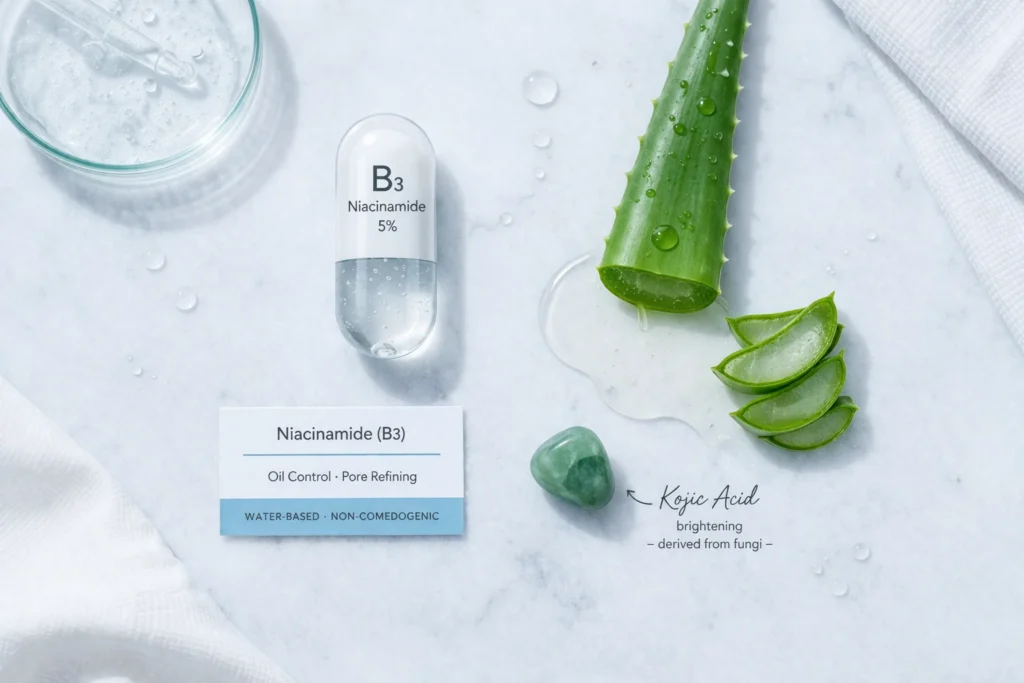
Niacinamide is the single most clinically validated brightening and sebum-regulating active for oily Indian skin. Its mechanism for oily skin operates at the sebaceous level: a clinical trial published in the Journal of Cosmetic Dermatology (PubMed/16766489) specifically tested topical 2% Niacinamide on Oriental (Japanese) subjects in a double-blind, placebo-controlled trial and found significant reduction in sebum excretion rates at both Week 2 and Week 4 compared to placebo. This makes Niacinamide the rare active that regulates the root cause — not just the symptoms — of oily skin over time.
Beyond sebum regulation, a 2024 PubMed multifunctional Niacinamide review confirms that Niacinamide at 2–5% reduces inflammatory acne lesions, strengthens the skin barrier, blocks melanin transfer, and supports collagen synthesis — making it a four-in-one active for oily skin dealing with the acne + PIH + oiliness cycle common in Indian skin. A PMC mechanistic review (2024) further confirms that clinical preparations of 2–5% Niacinamide consistently demonstrate sebum reduction across multiple independent studies.
Oily skin in India means breakouts. Breakouts on Fitzpatrick III–V skin mean PIH. PIH is the dark mark that persists for three to six months after the pimple has healed — and it compounds with every new breakout. Kojic Acid directly addresses this by inhibiting tyrosinase, the enzyme that converts the inflammation signal into melanin. A 2023 PMC hyperspectral imaging study documented 75% brightness improvement and 83% reduction in pigmentation contrast with consistent Kojic Acid use. For oily Indian skin, its leave-on night cream application is particularly effective: applied at night, it works during the UV-free window when there is no competing UV signal re-activating melanin production.
Aloe Vera is both a brightening active (via aloesin, a tyrosinase inhibitor) and the ideal delivery base for oily skin formulations. It is water-rich, non-greasy, non-comedogenic, anti-inflammatory, and has significant published evidence for barrier support and hydration without adding sebaceous load. For oily skin that is chronically over-stripped, Aloe Vera’s acemannan polysaccharide provides barrier restoration without the occlusion that would trap sebum in the follicle. It also reduces the low-grade inflammation that in oily acne-prone Indian skin generates new PIH — making it an anti-dark-spot ingredient as well as a barrier one.
The category ‘night cream’ is too broad to be trusted on its own. The wrong formulation is actively damaging for oily Indian skin. Here is what to always check the back label for:
| Avoid | Why It Hurts Oily Skin | How to Spot It on the Label |
|---|---|---|
| Silicones | Form a surface film that traps sebum, dead cells, and bacteria in the follicle — directly generating comedones in humid Indian conditions. Most common cause of night cream breakouts. | Dimethicone, Cyclopentasiloxane, Cyclohexasiloxane, Phenyl Trimethicone, any -siloxane or -methicone ending |
| Denatured or Isopropyl Alcohol | Strips the surface lipid layer causing acute dehydration. Sebaceous glands respond within hours with more sebum — creating the tight-then-oily cycle. | Alcohol Denat., SD Alcohol, Isopropyl Alcohol, Ethanol (in high concentration) |
| Heavy Comedogenic Oils | Coconut oil, cocoa butter, flaxseed oil, and similar high-comedogenicity oils block the follicle opening. Even “natural” oils are comedogenic for oily skin. | Cocos Nucifera (Coconut) Oil, Theobroma Cacao Butter, Linum Usitatissimum (Flaxseed) Oil in high concentrations |
| Synthetic Fragrance | Triggers contact dermatitis and micro-inflammation — on oily acne-prone skin, inflammation directly worsens breakout frequency and PIH severity. | Parfum, Fragrance, “natural fragrance”, Linalool, Limonene |
| Parabens | Hormone-disrupting preservatives that can affect sebaceous gland activity over time — particularly a concern for oily skin driven by androgenic hormones. | Methylparaben, Propylparaben, Butylparaben, Ethylparaben |
Not everything claiming to be non-comedogenic actually is. Here is the formulation checklist that genuinely protects oily skin:
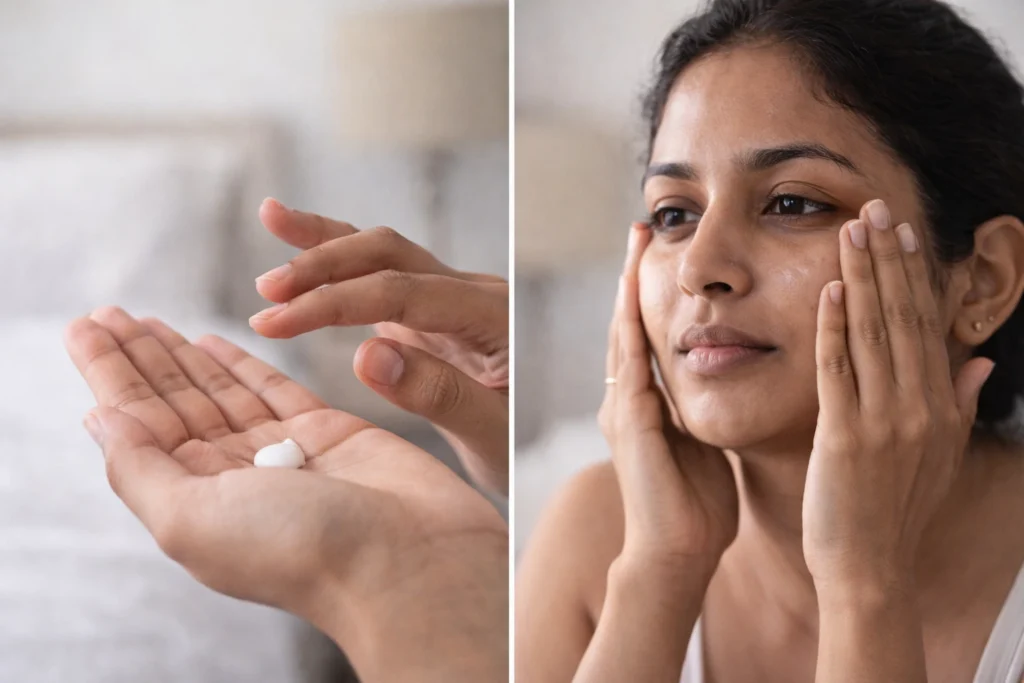
For oily Indian skin, the evening cleanse is the most important step in the whole routine — more so than for any other skin type. The day accumulates SPF, PM2.5 pollution particles, oxidised sebum, and comedone-forming residue that compounds in humid South Indian climates. A sulfate-free, gentle face wash used for 45–60 seconds (not a quick splash) removes the surface load that would otherwise create congestion underneath your night cream. Do not skip this even if you have stayed home all day. Sebum oxidises and turns comedogenic whether or not you have been outdoors.
For oily skin, the dosing rule is absolute: pea-sized maximum. A rice-grain amount is sufficient for many oily skin types. Excess product does not penetrate further — it sits on the surface, creates the heavy, occlusive feeling that clogs pores overnight, and causes exactly the congestion that oily skin users are trying to avoid. Apply within 60 seconds of cleansing, on skin that is still slightly damp. Press gently into the skin with your fingertips — do not rub or drag. Dragging triggers micro-friction that causes PIH on Indian oily skin.
For oily Indian skin, the night cream is the final step. No additional serums, oils, or occlusives layered on top. Layering products on oily skin overnight — especially in humidity — traps everything between the layers and creates a breeding ground for congestion. A single correctly formulated night cream is both sufficient and more effective than a stacked routine for oily skin.
A freshly applied cream will transfer to a pillowcase before your skin has time to absorb it. Five to ten minutes of upright absorption time means the actives reach the skin and the pillowcase stays clean — reducing bacteria transfer back onto treated skin overnight.

Oily skin in South India and Kerala operates under compound conditions that make it meaningfully different from oily skin in Delhi or colder northern cities:
Humidity in coastal South India and Kerala regularly exceeds 80% — and even during drier months, the baseline humidity is significantly higher than northern India. High ambient humidity slows the evaporation of sebum and applied products from the skin’s surface. This means that heavier formulations, silicone-laden products, and thick occlusives that might be tolerable in a drier climate become actively problematic in South India. For Kerala oily skin specifically, the formulation requirement is non-negotiable: silicone-free, lightweight, water-based, and absorbed quickly.
The 18-year Kerala UV satellite study (PubMed 2024) found that over 79% of daily UV measurements across Kerala fall in the Very High to Extreme category year-round. For oily skin — which is already prone to breakouts and therefore to PIH — this means significantly more UV-triggered dark spots accumulating on top of post-acne PIH. The combination of Kojic Acid (UV-free window tyrosinase inhibition at night) and morning SPF 50+ is not a luxury skincare stack for Kerala oily skin. It is the minimum science-backed intervention for managing the specific pigmentation burden this climate creates.
Urban South Indian cities — Bengaluru, Kochi, Chennai — combine high pollution levels with humidity and heat. Pollution particles (PM2.5) bind to sebum and oxidise, forming a particularly sticky surface film that is more difficult to remove than sebum or pollution alone. For Kerala oily skin: double cleansing (oil cleanser first to dissolve SPF and oxidised sebum, followed by a gentle water-based cleanser) before applying your night cream is not excessive — it is the correct protocol for the specific environmental load that South Indian urban oily skin carries.
Alfa Beauty Night Cream was formulated specifically for Indian skin — including the subset of oily, combination, and acne-prone Indian skin that most night cream formulations actively make worse. Here is precisely how it meets every requirement on the oily skin checklist:
| What Oily Indian Skin Needs | How Alfa Beauty Night Cream Delivers It |
|---|---|
| Silicone-free formulation | Completely free of dimethicone, cyclopentasiloxane, and all silicone derivatives. No surface film, no follicle trapping, no congestion — particularly important in South India and Kerala's humidity. |
| Sebum regulation | Niacinamide at clinically studied concentration directly reduces sebum excretion rates over consistent use — confirmed in controlled trials. |
| PIH and dark spot fading | Kojic Acid inhibits tyrosinase during the overnight UV-free window — targeting PIH marks after breakouts. Supported by the PMC 2023 hyperspectral study (75% brightness improvement) and a dedicated Indian patient melasma RCT. |
| Non-comedogenic delivery | Alcohol-free, paraben-free, fragrance-free. Aloe Vera as the base ingredient — water-rich, non-comedogenic, anti-inflammatory, and specifically used in oily skin formulations because it hydrates without adding comedogenic load |
| Acne + PIH dual action | Niacinamide reduces acne inflammation (6 of 8 clinical studies showed significant acne reduction per PubMed review) AND blocks the PIH-generating melanin transfer that follows every breakout. One active, both problems. |
| Lightweight for Indian humidity | Water-based formulation. No heavy oils. Absorbs quickly without greasy residue — tested for Indian climate conditions. |
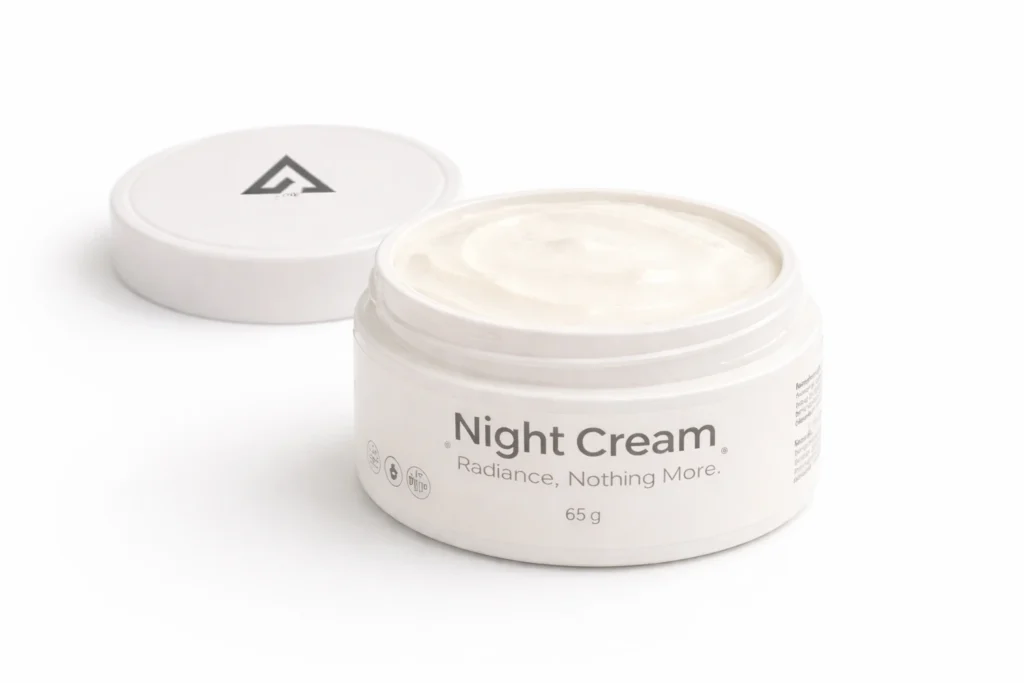
Kojic Acid + Niacinamide + Aloe Vera — Made for Indian Skin
₹849 (20% OFF — Launch Offer)
Oily skin responds to a correctly formulated non-comedogenic night cream differently than other skin types. Here is the honest week-by-week expectation:
| Timeframe | What Oily Skin Will Notice | What Is Happening |
|---|---|---|
| Days 1–7 | Skin feels less tight after cleansing. Morning texture slightly smoother. No visible pore or oil change yet. | Barrier hydration begins stabilising. Aloe Vera supports barrier repair. The dehydration-overproduction signal starts to reduce. |
| Weeks 2–3 | T-zone appears less excessively oily by mid-morning. Fewer new comedones forming. Slightly more even surface texture. | Niacinamide’s sebum reduction becomes measurable. Melanin transfer block begins accumulating. |
| Weeks 3–6 | PIH marks from breakouts visibly lighter. Skin tone more even. New breakouts leave lighter marks. T-zone oiliness more manageable. | Kojic Acid inhibition working cumulatively. Old pigment sheds via accelerated cell turnover. New PIH forms from a lighter baseline. |
| Weeks 6–12 | Consistent brightness. Reduced existing PIH. Noticeably less midday oil. Skin more resilient to new breakouts. | Barrier fully restored — oil overproduction cycle broken. Niacinamide regulation at peak effectiveness. |
| Month 3+ | New baseline: less oily, less reactive, fewer PIH marks. Skin responds better to all products. | Stable skin behaviour. Barrier interrupts inflammation → PIH cycle. Sebum activity normalised. |
Non-comedogenic. Silicone-free. Niacinamide-led. Every night. Without exception.
Oily skin’s excess oil is on the surface. The dehydration driving it is deeper. A pea-sized amount of the right non-comedogenic night cream applied consistently — on cleansed skin, before midnight, followed by SPF every morning — breaks the cycle. The Alfa Beauty Night Cream was built specifically for this: non-greasy enough to wear in Indian humidity, clinically evidenced enough to reduce the sebum overproduction causing it, and clean enough to apply to acne-prone Indian skin without adding a single ingredient it does not need.